
Table of Contents
- Understanding Cyclical Breast Tenderness and Hormonal Fluctuations
- Step 1: Choose a Supportive Bra and Adjust Fit
- Step 2: Apply Hot and Cold Compresses for Immediate Relief
- Step 3: Vitamins for Breast Tenderness and Hormonal Support
- Step 4: Modify Your Diet to Reduce Fluid Retention and Inflammation
- Lifestyle Changes for PMS Relief and Symptom Management
- When to See a Doctor for Breast Pain and Severe Symptoms
- Frequently Asked Questions
Last Updated: September 20, 2026
Understanding Cyclical Breast Tenderness and Hormonal Fluctuations
Cyclical breast tenderness, also called cyclical mastalgia, is breast pain that follows your menstrual cycle. It typically peaks during the luteal phase, the second half of your cycle after ovulation. This happens because hormonal fluctuations trigger swelling and inflammation in breast tissue.
The tenderness is tied directly to progesterone and estrogen levels. Many women experience soreness, heaviness, or sharp pain. You can reduce period breast tenderness naturally without relying solely on medication.
This guide covers proven strategies to ease discomfort during your cycle, from choosing the right bra to knowing when to see a doctor.
Cyclical breast tenderness is caused by hormonal changes, not injury. It peaks in the luteal phase and responds well to targeted natural remedies combined with lifestyle adjustments.
Step 1: Choose a Supportive Bra and Adjust Fit
A supportive bra is your first line of defense against period breast tenderness.
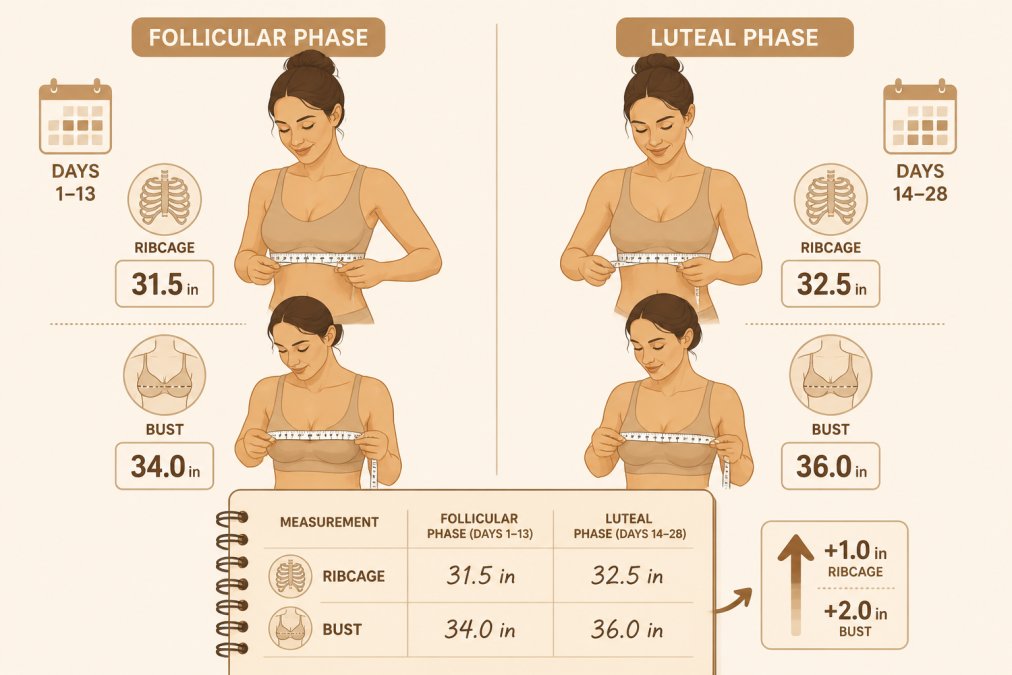
How to measure yourself at home for cycle-aware fitting:
Step 1: Measure your band size (do this during your follicular phase when breasts are smallest).
- Wear an unpadded bra or no bra.
- Measure snugly around your ribcage directly under your bust with a soft measuring tape.
- Keep the tape parallel to the ground.
- Round to the nearest whole number. This is your true band size.
- Example: If you measure 34 inches, your band size is 34.
Step 2: Measure your bust for cup size (measure twice, once in each phase).
- Measure loosely around the fullest part of your bust, keeping the tape parallel to the ground.
- Do this measurement during your follicular phase and again during your luteal phase (around day 21).
- Subtract your band measurement from your bust measurement. Each full inch of difference equals one cup size (A = 1 inch, B = 2 inches, C = 3 inches, D = 4 inches, etc.).
- Example: If your bust measures 37 inches and your band is 34, the difference is 3 inches = C cup during follicular phase. If your bust measures 38.5 inches during luteal phase, the difference is 4.5 inches = between D and DD cup.
Step 3: Understand your two-bra system.
- Follicular phase bra: This is your everyday bra. It should fit snugly without spillage or gaps. The band should sit level around your ribcage. Straps should sit on your shoulders without digging in or slipping.
- Luteal phase bra: Keep a bra in a larger cup size (typically 1-1.5 sizes up from your follicular phase size) and possibly a band size up. This bra should feel comfortable, not tight, during the second half of your cycle. Many women find that a sports bra or bra with stretchy fabric works better during this phase because it accommodates swelling without the rigidity of an underwire.
Step 4: Check the fit in both phases.
- Band fit: The band should sit parallel to the ground in the front and back. If it rides up in the back, it’s too large. If you can’t fit one finger under the band, it’s too tight.
- Cup fit: Your breast should fill the cup completely with no spillage at the sides or top, and no empty space or wrinkles at the bottom. If you see spillage, go up a cup size. If you see gaps, go down a cup size.
- Strap placement: Straps should sit on the back of your shoulders, not on your neck or slipping off your arms. They should not dig into your shoulders.
- Underwire (if applicable): The underwire should sit flat against your ribcage, not poking into breast tissue or gapping away from your body.
Practical tips for managing two bra sizes:
- Keep one well-fitted bra in your follicular phase size and one affordable sports bra in your luteal phase size.
- Set a phone reminder on day 15 to switch to your larger bra.
- Look for bras with adjustable straps and multiple hook-and-eye closures to loosen the band as swelling increases.
:::pro-tip
If you’ve never measured yourself during your luteal phase, you may be surprised by how much your size changes. Many women discover they need a full cup size larger and sometimes a band size up. This single adjustment often reduces tenderness by 30-40% because you’re eliminating unnecessary compression during the time when your breasts are most sensitive.
Bras lose elasticity after 6-12 months of regular wear. Remeasure yourself every 1-2 years, as size may shift due to weight changes or hormonal shifts.
Step 2: Apply Hot and Cold Compresses for Immediate Relief
Temperature therapy works fast. Hot compresses relax muscle tension around the breast. Cold compresses numb pain and reduce inflammation. Alternating between the two gives you the best results.
Step 3: Vitamins for Breast Tenderness and Hormonal Support
Vitamin B6 (Pyridoxine)
Vitamin B6 supports progesterone production and reduces fluid retention.
- Typical dose: 50-100 mg daily during the luteal phase (days 15-28).
- Expected timeline: 2-3 cycles to notice improvement.
- Safety note: Do not exceed 200 mg daily long-term; high doses can cause nerve damage. Stay at 50 mg if taking longer than 3 months.
- Contraindications: Can interact with SSRIs and levodopa. Consult your doctor before starting.
Vitamin E (Tocopherol)
- Typical dose: 400 IU daily with food.
- Expected timeline: 2-3 months to notice improvement.
- Safety note: Do not exceed 1,000 IU daily without medical supervision.
- Contraindications: Mild blood thinner. Check with your doctor if you take blood thinners, aspirin, or have a bleeding disorder.
Magnesium
- Typical dose: 300-500 mg daily in the evening.
- Expected timeline: 1-2 cycles to notice improvement.
- Safety note: Can cause loose stools; switch to magnesium glycinate if needed.
- Contraindications: Space 2 hours apart from antibiotics and calcium supplements. Consult your doctor if you take bisphosphonates.
Evening Primrose Oil (EPO)
- Typical dose: 1,500-3,000 mg daily from day 1 through ovulation (day 14).
- Expected timeline: 3-4 cycles to notice improvement.
- Contraindications: Mild blood thinner; avoid if you use blood thinners, aspirin, or have a bleeding disorder. May interact with hormonal birth control; discuss with your doctor.
| Vitamin/Supplement | Typical Dose | When to Take | Expected Timeline | Key Contraindication |
|---|---|---|---|---|
| Vitamin B6 | 50-100 mg | Daily during luteal phase | 2-3 cycles | SSRIs, Parkinson’s medications; max 200 mg daily long-term |
| Vitamin E | 400 IU | Daily with food | 2-3 months | Blood thinners, aspirin, bleeding disorders |
| Magnesium | 300-500 mg | Evening | 1-2 cycles | Antibiotics (space 2 hours apart), bisphosphonates, calcium supplements |
| Evening Primrose Oil | 1,500-3,000 mg | Days 1-14 of cycle | 3-4 cycles | Blood thinners, birth control (check with doctor) |
How to start supplements safely:
- Start with one supplement at a time to track effectiveness and identify side effects.
- Give each supplement at least two full cycles before deciding if it’s working.
- Keep a symptom log with dates, doses, and tenderness severity (1-10 scale).
- Check for interactions with your doctor or pharmacist before starting.
- Buy from reputable brands with third-party testing certifications (USP, NSF, ConsumerLab).
If you take birth control, blood thinners, antibiotics, or have a bleeding disorder, do not start any of these supplements without consulting your doctor or pharmacist first. Several of these supplements interact with common medications, and the interactions can be significant. Your healthcare provider can help you determine safe dosing and timing, or recommend alternative approaches if supplements aren’t appropriate for you.
Combining magnesium with vitamin B6 often produces faster results, as they work through different mechanisms. Start both at the lower end of the dosing range and monitor for side effects.
Step 4: Modify Your Diet to Reduce Fluid Retention and Inflammation
What you eat directly affects how much fluid your body retains during the luteal phase. Fluid retention puts pressure on breast tissue and amplifies tenderness. Dietary changes can reduce this pressure significantly.
Lifestyle Changes for PMS Relief and Symptom Management
Beyond targeted interventions, your daily habits shape how severe period breast tenderness becomes. Small changes compound into significant relief.
Consistent lifestyle changes, exercise, stress management, sleep, and tracking, often reduce period breast tenderness as much as supplements. They cost nothing and benefit your overall health.
When to See a Doctor for Breast Pain and Severe Symptoms
Most cyclical breast tenderness responds to natural remedies within 1-3 cycles. But some pain warrants professional evaluation.
See a doctor if:
- Pain limits daily activities for more than 5-7 days per cycle
- Tenderness is one-sided only
- You notice lumps, discharge, or skin changes
- Pain doesn’t follow your menstrual cycle
- Symptoms worsen despite trying multiple remedies for 3+ cycles
Frequently Asked Questions
What vitamin helps with breast tenderness?
Vitamin B6, vitamin E, and magnesium are the most studied nutrients for reducing cyclical breast tenderness. Vitamin B6 helps regulate progesterone levels during your menstrual cycle, while vitamin E has anti-inflammatory properties. Magnesium reduces fluid retention and soreness. Many women find that supplementing with these vitamins, either individually or through a comprehensive formula, reduces tenderness severity by 20-30% within 2-3 cycles. Start with recommended daily amounts and give your body time to respond.
Can dietary changes help reduce breast pain during PMS?
Yes. Reducing caffeine intake is one of the most effective dietary adjustments, as caffeine can increase breast tenderness and swelling. Lowering fat intake and increasing fiber also helps minimize fluid retention and inflammation. Staying hydrated throughout your cycle supports lymphatic drainage and reduces bloating. Avoiding excess salt before your period prevents water retention that worsens soreness. These changes work best when combined with other natural remedies like supportive bras and compresses.
How long do breasts stay sore during your period?
Cyclical breast tenderness typically begins 1-2 weeks before your period starts (during the luteal phase) and resolves within a few days after menstruation begins. The soreness usually peaks 3-5 days before your period. If tenderness lasts beyond your period or occurs at random times in your cycle, consult a healthcare provider to rule out non-cyclical causes. Tracking your symptoms helps identify patterns and determines which natural remedies work best for your cycle.
Can I use natural remedies if I’m taking birth control?
Most natural remedies for breast tenderness are safe alongside birth control, but interactions are possible. Magnesium, vitamin B6, and vitamin E generally don’t interfere with hormonal contraceptives. Evening primrose oil, however, may affect blood clotting and could interact with certain medications. Always inform your healthcare provider about any supplements you’re taking, especially if you’re on birth control or other medications. They can confirm whether specific remedies are appropriate for your individual health profile.