
Table of Contents
- Yoga Poses to Relieve Period Pain: What You Need to Know First
- 1. Child’s Pose (Balasana): The Resting Reset
- 2. Knees-to-Chest (Apanasana): Releasing Lower Back Tension
- 3. Cat-Cow (Marjaryasana-Bitilasana): Gentle Spinal Flow
- 4. Bound Angle Pose (Baddha Konasana): Opening the Hips
- 5. Supine Twist and Other Reclining Poses for Abdominal Relief
- 6. Cobra Pose and Sphinx: Gentle Backbends for Pelvic Discomfort
- The Best Position for Period Cramps When You’re Not Doing Yoga
- Frequently Asked Questions
Last Updated: October 9, 2026
Yoga Poses to Relieve Period Pain: What You Need to Know First
Yoga poses to relieve period pain work best when you treat them as comfort, not cure. This guide from cycle 180 walks through six gentle poses you can do at home, in order, with clear steps and honest expectations. Menstrual cramps happen when the uterine muscles tighten and reduce blood flow. Gentle movement, breathing, and stretching can ease that tension. They will not erase severe period pain, and we will be upfront about that.
Here is what most guides skip: the goal is not to push through discomfort. The goal is to relax the muscles around your hips, lower back, and belly.
What You’ll Need Before You Start
You need very little to begin. A mat or a soft rug, a folded blanket or pillow, and loose clothing are enough.
- A quiet space where you can lie down flat
- A blanket for padding under your knees or hips
- Water nearby
- Ten to fifteen minutes of unhurried time
A few ground rules. Move slowly. Breathe through each pose. Stop if any position sharpens the pain instead of easing it.
Never force a stretch during your period. Pushing into sharp pain can tighten the muscles you are trying to relax, which makes cramping worse, not better.
If your cramps are severe enough that you cannot stand, skip the sequence and rest. Yoga is a comfort tool, not a replacement for medical care.
1. Child’s Pose (Balasana): The Resting Reset
Child’s Pose is the gentlest place to start. It takes pressure off your lower back and lets your belly rest.
How to do it:
- Kneel on your mat with your big toes touching.
- Spread your knees wide, about mat-width apart.
- Sit back toward your heels.
- Fold forward and rest your forehead on the mat.
- Stretch your arms forward or let them rest by your sides.
- Breathe slowly for 5 to 10 breaths.
If your knees feel tight, slide a folded blanket behind them. If your forehead does not reach the mat, stack your hands under it.
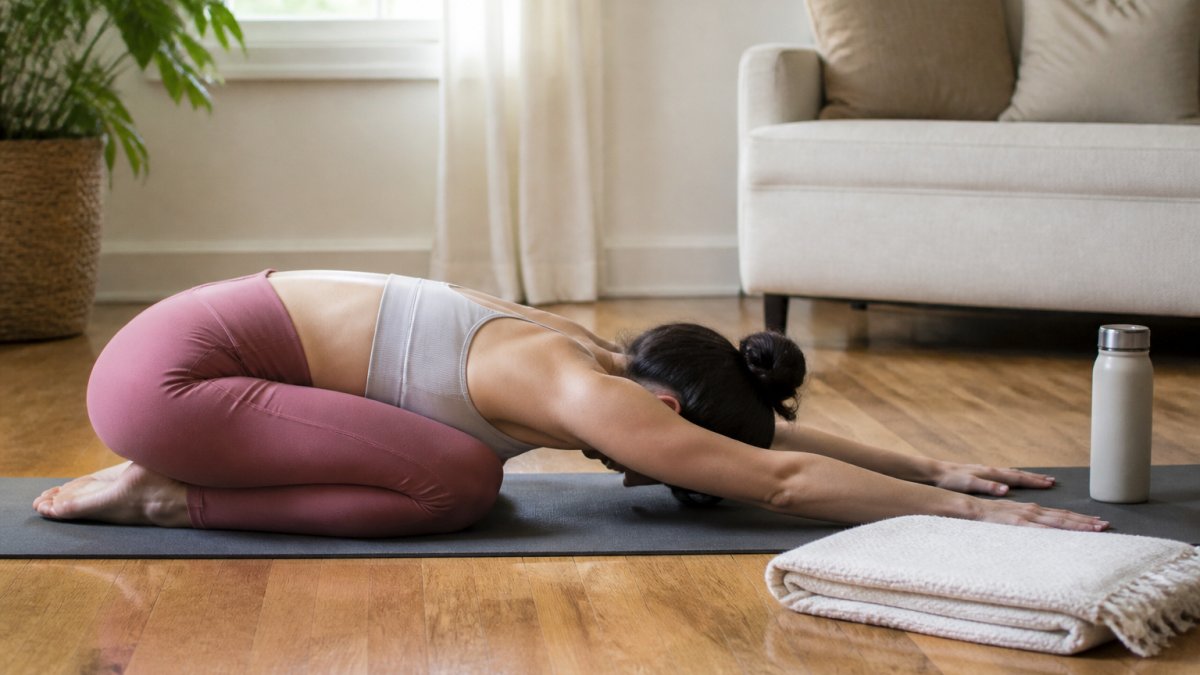
This pose is the reset button. Return to it any time the sequence feels like too much.
2. Knees-to-Chest (Apanasana): Releasing Lower Back Tension
Knees-to-chest targets the lower back, where period pain often settles. It is one of the simplest poses to relieve period pain because it needs almost no effort.
- Lie on your back on the mat.
- Bend your knees and bring them toward your chest.
- Wrap your arms around your shins or behind your thighs.
- Gently rock side to side if it feels good.
- Hold for 5 to 10 slow breaths.
- Lower one foot at a time to release.
You can do one leg at a time if both knees feel like too much. The rocking motion adds a light massage to the lower back.
A slow side-to-side rock in this pose often releases lower back tightness faster than holding still. Keep the movement small and let your breath set the pace.
3. Cat-Cow (Marjaryasana-Bitilasana): Gentle Spinal Flow
Cat-Cow is a gentle yoga flow for period pain because it moves the spine without straining the belly. It warms up your back and hips before deeper stretches.
- Come onto your hands and knees.
- Place your wrists under your shoulders and knees under your hips.
- Inhale and drop your belly, lifting your chest and tailbone. This is Cow.
- Exhale and round your spine, tucking your chin. This is Cat.
- Move slowly between the two for 8 to 10 rounds.
Let your breath lead. Inhale into Cow, exhale into Cat. If your wrists ache, rest on your forearms instead.
4. Bound Angle Pose (Baddha Konasana): Opening the Hips
Bound Angle, also called Butterfly Pose, opens the hips and inner thighs. Tight hips can add to pelvic discomfort, so this pose earns its place in the sequence.
- Sit on the mat with your legs extended.
- Bend your knees and bring the soles of your feet together.
- Let your knees fall out to the sides.
- Hold your feet or ankles.
- Sit tall and breathe for 5 to 10 breaths.
If your hips feel tight, sit on a folded blanket. You can also place pillows under each knee for support. Never press your knees down with your hands.
5. Supine Twist and Other Reclining Poses for Abdominal Relief
A supine twist releases the lower back and side body while you stay supported on the floor. It is one of the best reclining options when you feel tired.
- Lie on your back with your legs extended.
- Pull your right knee toward your chest.
- Guide the knee across your body to the left with your hand.
- Extend your right arm out to the side and turn your head right.
- Hold for 5 breaths, then switch sides.
Other reclining poses worth trying: Reclining Bound Angle, where you lie back with the soles of your feet together, and Happy Baby, where you hold your feet and gently rock. Both keep you off your feet and let gravity do the work.
6. Cobra Pose and Sphinx: Gentle Backbends for Pelvic Discomfort
Cobra Pose and Sphinx are gentle backbends that stretch the front of the body and may ease pelvic discomfort. They are the most active poses in this sequence, so save them for when you feel steady.
Sphinx:
- Lie on your stomach.
- Prop yourself on your forearms with elbows under your shoulders.
- Keep your hips and legs on the mat.
- Breathe for 5 breaths.
Cobra:
- Start on your stomach with hands under your shoulders.
- Press lightly into your hands and lift your chest.
- Keep your elbows slightly bent.
- Hold for 3 to 5 breaths, then lower down.
If lying on your stomach feels uncomfortable, skip both. This is the one part of the sequence you can drop without losing much.
The Best Position for Period Cramps When You’re Not Doing Yoga
The best position for period cramps is usually on your side with your knees drawn up, or on your back with a pillow under your knees. Both take pressure off your lower belly and back.
When you are not practicing yoga poses, try these:
- Side-lying with a pillow between your knees
- On your back with knees bent over a bolster
- Knees-to-chest on the floor for a minute or two
- Sitting forward with a cushion against your belly
How long should you do yoga for period cramps? Ten to fifteen minutes is plenty. A short, gentle session beats a long, hard one. Repeat it once or twice a day if it helps.
When to See a Doctor
Some cramps need more than stretching. Talk to a healthcare provider if:
- Pain stops you from working or sleeping for days
- Over-the-counter pain relievers do not help
- You bleed heavily or pass large clots
- Pain gets worse over time, not better
These signs can point to conditions like endometriosis or fibroids. Yoga can support you alongside treatment, but it cannot diagnose or fix them. For general guidance on menstrual pain, the Office on Women’s Health is a solid starting point. The American College of Obstetricians and Gynecologists also covers when cramping warrants a visit.
Building a Daily Routine
A simple routine works better than an occasional long session. Here is how we would structure it:
| Time | Poses | Duration |
|---|---|---|
| Day 1-2 (heaviest) | Child’s Pose, Knees-to-Chest | 8-10 min |
| Day 3-4 | Cat-Cow, Bound Angle, Supine Twist | 12-15 min |
| Any day, low energy | Side-lying, Reclining Bound Angle | 5-8 min |
Pair the routine with steady habits. Staying hydrated, eating regularly, and getting enough sleep all support how you feel during your cycle. For a closer look at how diet and lifestyle shape menstrual comfort, the Cleveland Clinic has plain-language resources.
At cycle 180, our focus is daily menstrual wellness support. Our all-natural powdered supplement blends herbs, vitamins, and minerals into one drinkable mix, so you are not juggling a shelf of separate pills. It is built for women who want a simple daily ritual, whether your cycles are regular or shifting through perimenopause.
Frequently Asked Questions
How can I stop period pain asap?
For fast relief, try Knees-to-Chest pose (Apanasana) first. Lie on your back, pull both knees toward your chest, and hold for 30-60 seconds while breathing deeply. This releases lower back tension and eases abdominal pressure. A 2023 review in the Journal of Clinical Medicine found that yoga can reduce menstrual pain intensity, though results vary. Pair it with a heating pad and rest.
What is the best position for period cramps?
The best position for period cramps is often Child’s Pose (Balasana) or lying on your side with knees bent. These positions take pressure off your abdominal muscles and lower back. If you’re not doing yoga, lie on your back with a pillow under your knees. A small study in Complementary Therapies in Clinical Practice found that yoga poses like Child’s Pose helped reduce cramp severity in participants.
Is there a pressure point to relieve menstrual cramps?
Yes, the Spleen 6 (Sanyinjiao) point is commonly used in acupressure for menstrual cramps. It’s located about four finger-widths above your inner ankle bone. Apply firm, steady pressure with your thumb for one to two minutes on each leg. A 2021 systematic review in BMJ Open found that acupressure may help reduce period pain, though evidence quality varies. Combine it with gentle yoga for best results.
Should I avoid any yoga poses during my period?
Skip inversions like headstands and shoulder stands, as they can increase pelvic pressure. Also avoid intense backbends like full Wheel and deep twists that compress the abdomen. Stick to gentle poses like Child’s Pose, Cat-Cow, and Bound Angle. If you have heavy bleeding or severe pain, rest is more important than any pose. Listen to your body and stop if discomfort increases.
Period pain has a way of shrinking your whole day down to the couch. Gentle yoga helps, but it works best as one part of a routine that supports your body all month. Cycle 180 makes that routine easier with a single powdered blend of herbs, vitamins, and minerals designed for menstrual wellness, comfort, and everyday well-being. Get started with cycle 180 and build a daily ritual that works with your cycle, not against it.